
SEO blog automation for content teams: the short answer
SEO blog automation for content teams connects keyword research, topic selection, briefs, drafting, editorial review, on-page checks, CMS publishing, and performance review. Assign an owner and an approval step to each handoff. Start with one article and use the eight-step workflow below to make delivery repeatable while keeping factual checks and brand decisions with your team.
Organic growth rarely fails because a founder or growth marketer does not understand SEO. It fails because execution is relentless. Every week demands keyword research, search intent analysis, outlines, content briefs, drafting, on-page optimization, meta titles, internal links, publishing, and performance updates. For lean teams, that workload quickly competes with product launches, sales calls, customer support, and paid acquisition. This is where blog SEO automation becomes a practical growth lever rather than a nice-to-have tool.
The goal is not to replace strategy with a content machine that publishes generic articles. The goal is to build a repeatable system that turns your SEO strategy into consistent, high-quality execution. Larger companies often win because they have process, cadence, and resources. Blog SEO automation gives smaller teams a way to compete by operationalizing the parts of content marketing that should not require hours of manual work every time.
Why SEO Growth Breaks Down for Lean Teams
Most founders and growth marketers start with the right ambition: publish useful content, rank for relevant keywords, and convert search traffic into pipeline. The breakdown happens in the middle. A keyword list sits in a spreadsheet. Content ideas are discussed in Slack but never assigned. Drafts get delayed because the subject matter expert is busy. Published posts lack internal links, schema, metadata, or a clear CTA. A few months later, the blog looks active but does not produce reliable traffic growth.
This is not a creativity problem. It is an operating system problem. Search growth depends on doing many small things correctly, repeatedly, over a long period. The teams that win are not always the teams with the best writers. They are often the teams with the cleanest workflow from research to publication to optimization.
Recent shifts in search have made this even more important. Google continues to reward helpful, experience-driven content while penalizing thin, unoriginal pages. At the same time, AI search experiences, answer engines, and generative results are changing how users discover information. That means content teams now need to think beyond traditional rankings. They need strong topical authority, clean structure, trustworthy answers, and content that can be understood by both search engines and AI answer systems. Manual execution alone is becoming too slow for many lean teams.
What Blog SEO Automation Actually Means
Blog SEO automation is the use of software, workflows, and AI agents to automate the repeatable tasks involved in planning, optimizing, publishing, and improving blog content for organic search. It is not the same as typing a prompt into an AI writer and asking for a 1,500-word article.
Generic AI writing usually starts with a blank page and ends with a draft. Blog SEO automation starts much earlier and continues much later. It connects keyword strategy, search intent, buyer pain points, content structure, on-page SEO, internal linking, publishing schedules, and performance iteration into one repeatable system.
In a mature workflow, automation helps with tasks such as:
Identifying high-intent keywords with realistic ranking opportunities.
Grouping keywords into topics, clusters, and funnel stages.
Analyzing search intent and competitor coverage.
Creating SEO-ready briefs with headings, questions, entities, and internal link targets.
Drafting articles that match brand voice and reader expectations.
Optimizing titles, meta descriptions, URLs, headings, and readability.
Suggesting internal links and conversion paths.
Publishing to the CMS on a consistent schedule.
Tracking performance and flagging posts for refreshes.
The distinction matters. If automation only creates more content, you risk scaling noise. If automation improves the entire SEO workflow, you scale execution quality
Plan those handoffs in the B2B content calendar template. Agree on which AI content marketing tasks to automate before production, and use the blog automation quality checklist as the final editorial gate.
A Practical Blog SEO Automation Workflow
The strongest blog SEO automation systems are built around a workflow, not a collection of disconnected tools. Below is a practical model that works for founders, solo operators, and growth teams that need predictable output without adding headcount.
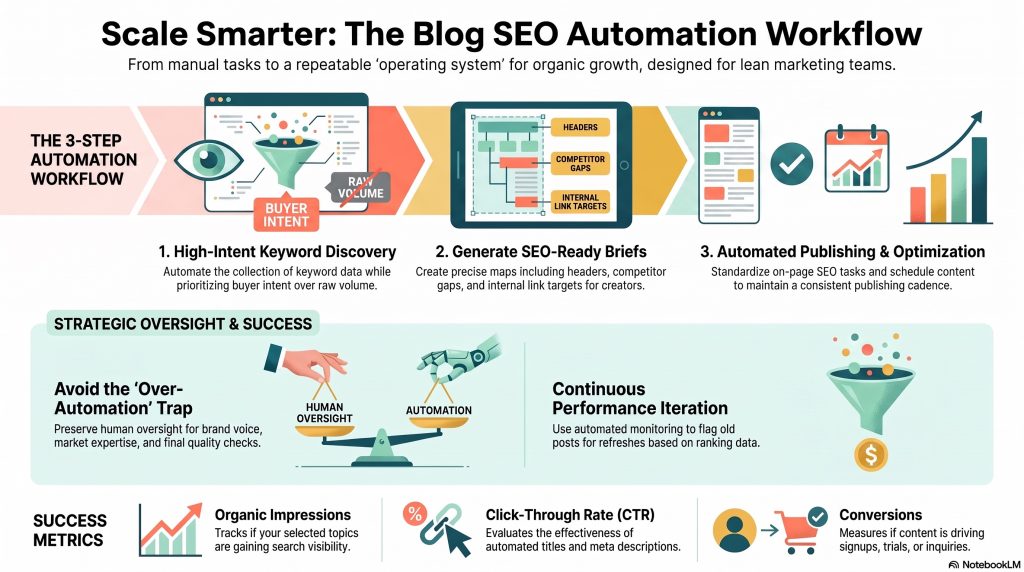
1. Start With High-Intent Keyword Discovery
Automation should not begin with writing. It should begin with choosing the right demand to capture. A high-volume keyword is not always a valuable keyword. For a B2B company, a lower-volume query with strong buying intent can be far more useful than a broad informational term that attracts unqualified readers.
Use automation to collect keyword data, but apply commercial judgment to the final selection. Look for phrases that reveal a business problem, evaluation behavior, or solution awareness. Examples include comparisons, alternatives, templates, workflows, calculators, implementation guides, and problem-specific how-to queries.
A strong automated keyword workflow should evaluate:
Intent: Is the searcher looking to learn, compare, buy, or implement?
Relevance: Does the topic connect to your product and buyer pain points?
Difficulty: Can your domain realistically compete?
Business value: Would ranking for this topic attract potential customers?
Cluster fit: Does the keyword support a broader topic you want to own?
For Wordiva’s audience, this means prioritizing topics around AI content marketing, blog automation, SEO optimization, brand intelligence, autonomous publishing, AEO optimization, GEO optimization, backlinking, and traffic growth. The keyword universe should reflect how your buyers describe their problems, not just how SEO tools label a category.
2. Map Topics to Buyer Pain Points
Search traffic is only useful if it attracts the right audience. A common mistake is building content around keywords that have search volume but no clear relationship to the buyer’s urgency. Blog SEO automation should help map every topic to a specific pain point, persona, and stage of awareness.
For example, a solo founder searching for ways to automate blog publishing probably feels time pressure. A growth marketer searching for SEO content workflow automation may be trying to scale output without compromising quality. A B2B founder searching for organic traffic strategy may be comparing content marketing against paid acquisition. These distinctions should influence the outline, examples, CTA, and depth of explanation.
Before generating a brief, define:
Who is searching?
What job are they trying to get done?
What have they already tried?
What objection or risk is in their mind?
What next step would be genuinely useful?
This is where brand intelligence becomes important. A system that understands your positioning, product, audience, tone, and conversion goals can create content that sounds connected to your business rather than pasted from a generic template.
3. Generate SEO-Ready Content Briefs
The brief is where many SEO programs either gain leverage or lose quality. Without a clear brief, writers guess at intent, structure, examples, internal links, and the angle. With a strong brief, drafting becomes faster and more consistent.
Blog SEO automation can produce briefs that include the primary keyword, secondary keywords, search intent, recommended headings, competitor gaps, frequently asked questions, internal link opportunities, suggested title tags, meta descriptions, and conversion angle. This gives the content creator a precise map instead of a blank page.
Competitive analysis is especially valuable here. Many top-ranking articles on SEO automation cover tool lists, basic definitions, or broad AI writing advice. The gap for lean B2B teams is practical operating detail: how to connect research, strategy, drafting, optimization, and publishing into one workflow. Your content can differentiate by showing the system behind the output.
4. Draft Optimized Articles Without Losing Originality
Drafting is where automation saves visible time, but it is also where quality risk is highest. A draft should not simply summarize search results. It should add a clear perspective, examples, structure, and decisions that reflect your market knowledge.
A reliable blog SEO automation workflow should create drafts that follow the brief while preserving room for editorial judgment. The article should answer the query directly, cover the necessary subtopics, and include a point of view. It should not be padded with generic sections that say everything and teach nothing.
For B2B content, this usually means writing with the buyer’s reality in mind. A founder does not need a lecture on why SEO matters. They need to know which parts can be automated, which parts need oversight, how to avoid publishing weak content, and how to build a cadence they can sustain.
The best use of automation is not to make content feel automated. It is to remove the operational drag that keeps good content from being produced consistently.
5. Check Readability, Brand Voice, and Trust Signals
Search engines and readers both reward clarity. Automated SEO content should go through a quality layer before publication. This is where you check whether the article is readable, accurate, specific, and aligned with your brand voice.
Important checks include:
Does the introduction address the reader’s real problem quickly?
Do the headings create a logical path through the topic?
Is the content specific enough to be useful?
Are claims supported by context, examples, or credible reasoning?
Does the article avoid exaggerated promises?
Is the CTA relevant to the reader’s stage of intent?
Does the piece sound like your company, not a generic AI model?
This step is essential for AEO optimization and GEO optimization as well. Answer engines tend to favor content that is well-structured, direct, and semantically clear. If your content defines concepts cleanly, answers common questions, and organizes ideas in a way machines can parse, it has a better chance of being surfaced in AI-assisted search experiences.

6. Automate On-Page SEO and Internal Linking
On-page SEO is full of small tasks that are easy to miss when a team is moving fast. Title tags, meta descriptions, H2 structure, image prompts, slug formatting, schema, internal links, and CTA placement all influence performance. None of these should require reinventing the process for every post.
Blog SEO automation can standardize these steps. It can suggest a concise SEO title, generate a click-worthy meta description, create a clean URL slug, recommend internal links to relevant posts or product pages, and ensure the article includes the right keyword variations naturally.
Internal linking deserves special attention. Many lean teams publish articles in isolation. That weakens topical authority and leaves readers without a path to deeper content. Automated internal link suggestions help connect new posts to existing clusters, product pages, and conversion assets. Over time, this makes the entire blog more discoverable and more useful.
7. Publish on a Consistent Schedule
Consistency is one of the biggest advantages of blog SEO automation. SEO rewards cumulative effort, but lean teams often publish in bursts. Three articles go live in one week, then nothing for a month. This makes it harder to build topical authority, maintain momentum, and learn from performance data.
Automated publishing solves the operational gap between approved content and live content. A system can prepare the post, format it for the CMS, add metadata, schedule publication, and reduce the manual handoff that often delays execution.
That does not mean publishing every day is the goal. The right cadence depends on your market, resources, and quality bar. For many B2B teams, one to three strong articles per week is more valuable than high-volume publishing that lacks depth or editorial care.
8. Refresh and Iterate Based on Performance
SEO content is not finished when it is published. Some posts need updated examples. Some need stronger internal links. Some rank on page two and require more depth to break through. Some attract traffic but fail to convert because the CTA does not match intent.
A complete blog SEO automation system should monitor performance and surface opportunities. That might include declining rankings, posts with high impressions but low click-through rate, articles ranking for unexpected keywords, or pages with traffic but weak engagement.
This is where automation compounds. Every article becomes data for the next decision. Instead of guessing what to publish or refresh, your workflow can prioritize the highest-impact actions.
Where Blog SEO Automation Can Go Wrong
Automation creates leverage, but it also magnifies weak strategy. If the inputs are poor, the output scales the wrong things faster. The biggest risks are thin content, keyword-first thinking, and removing human judgment from decisions that require market understanding.
Watch for these failure modes:
Over-automation: Publishing without editorial review can lead to inaccuracies, repetition, and weak positioning.
Ignoring search intent: A perfectly optimized article can still fail if it answers the wrong question.
Thin content: Articles that restate obvious advice rarely earn rankings, links, or trust.
No brand perspective: If your article could appear on any competitor’s blog, it is not doing enough for your business.
Volume without strategy: More posts do not guarantee more qualified traffic.
No refresh process: Old content can decay if it is not maintained.
The solution is not to avoid automation. It is to automate the right layers. Let systems handle research support, brief generation, optimization checks, formatting, and publishing. Keep human oversight on positioning, expertise, product alignment, and final quality.
How Wordiva Connects SEO Strategy to Publishing
Wordiva is built for the teams that understand content matters but cannot afford to turn blogging into a full-time operational burden. As an agentic AI content marketing engine, Wordiva automates the blog content lifecycle from brand intelligence and strategy to drafting, SEO optimization, and auto-publishing.
That matters because the real bottleneck is rarely one isolated step. A founder may have ideas but no time to turn them into search-optimized posts. A growth marketer may have keyword data but no capacity to brief, draft, optimize, and publish consistently. A small B2B team may understand its audience deeply but lack the process to turn that knowledge into a scalable organic growth engine.
Wordiva brings those pieces together. It uses brand intelligence to understand your positioning and audience, supports SEO strategy with topic and keyword direction, creates optimized drafts, checks for readability and alignment, and helps maintain a consistent publishing cadence. Instead of stitching together spreadsheets, AI writing tools, SEO plugins, and CMS workflows, teams can run a more connected blog SEO automation process.

What to Measure After Automating Blog SEO
Once your workflow is automated, do not judge success only by the number of articles published. Output matters, but outcomes matter more. Track metrics that show whether content is attracting the right readers and moving them toward action.
Key metrics include:
Organic impressions: Are your topics gaining visibility?
Keyword rankings: Are priority pages moving into competitive positions?
Click-through rate: Are your titles and meta descriptions earning clicks?
Organic sessions: Is traffic growing from relevant searches?
Engaged time: Are readers consuming the content?
Internal link clicks: Are visitors moving deeper into your site?
Conversions: Are articles contributing to signups, demos, trials, or inquiries?
Content refresh impact: Do updates improve rankings and traffic?
This measurement loop keeps automation accountable. The goal is not to publish because the system can. The goal is to increase qualified organic traffic, improve topical authority, and create a durable acquisition channel.
SEO Blog Automation for Content Teams FAQ
How does SEO blog automation for content teams work?
Use one approved brief to connect keyword research, topic selection, drafting, review, SEO checks, and publishing. Give each article an owner, status, and target date. Automate repeatable checks and handoffs, then have the owner approve the facts, examples, and final page.
How do I automate publishing AI-optimized articles to my CMS?
Use a publishing integration supported by your CMS to create a draft from an approved article. Map the title, body, slug, excerpt, author, images, categories, and SEO fields. Preview formatting, links, and metadata before scheduling. After publishing, confirm that the intended URL loads, the canonical is correct, and the article appears once. Route failed jobs to a reviewer before retrying so you do not create duplicate posts.
Which SEO checks should happen before an automated post goes live?
Confirm that the article answers the intended query and that claims have supporting sources. Check the title, description, headings, image descriptions, internal link destinations, canonical URL, and indexing settings. Read the CMS preview and approve the final version before the publishing step runs.
Does automating blog SEO guarantee more traffic?
No. Automation can make production more consistent, but traffic depends on relevance, content quality, competition, and whether search engines can discover and index the page. Monitor query-level impressions, clicks, click-through rate, and relevant conversions; use those results to decide which articles need revision.
Final Thoughts: Build the System, Not Just the Article
SEO growth is not built from occasional bursts of content. It is built from a repeatable workflow that identifies the right opportunities, turns them into useful articles, optimizes every page, publishes consistently, and improves based on performance. For lean teams, doing all of that manually is often the difference between having an SEO strategy and actually executing it.
Blog SEO automation gives founders and growth marketers a way to scale without immediately expanding the content team. Used well, it reduces manual work while preserving strategic control. Used poorly, it creates more pages without more value. The difference is whether automation is connected to buyer insight, search intent, brand voice, and ongoing optimization.
If your team is ready to turn blogging into a more predictable growth channel, Wordiva can help automate the workflow from strategy to drafting, SEO optimization, and autonomous publishing. Instead of managing every step manually, you can build a content engine that stays aligned with your brand, your audience, and your organic growth goals.
Automate your blog SEO workflow with Wordiva and give your team the operating system it needs to publish consistently, optimize intelligently, and grow traffic without adding unnecessary complexity.